Friday, May 20, 2016

Blood Draws: Unbruised, Unbullied

Blood Draws: Unbruised, Unbullied

Of all the pokes and bloody awfulness of diabetes, having blood drawn every few months is the worst.  I don't mind pricking my fingers several times a day or injecting insulin or even inserting the sensor. However, horrible experiences getting my blood drawn for labwork left me traumatized. I'd read all the tips (drink lots of water), but none of them really prevented the bruising.

Then I discovered my secret.

Just Say No.

I look them in the eye and tell them:  You get one chance.  If you can't get blood, I will leave and return another day.
No digging.  
No trying the other arm.
If you don't think you can do it, is there anyone here who can?

I've heard "Your doctor will be angry if she doesn't get the labs."  I reply, "Then you can explain why you were unable to do it."

I have a friend who teaches phlebotomy at the local college.  She told me that if the blood doesn't immediately go into the vial, the phlebotomist should ask a more experienced person to do the procedure.  They are not to dig or keep poking.  The sample can get contaminated by the debris, requiring another blood draw.

A good phlebotomist can get the blood on the first poke and minutes later, the only evidence on the inside of my arm is a tiny, faint dot where the needle entered.  Phlebotomists who hurt people and leave bruises on both arms  are bad phlebotomists who should find another line of work.  They should not bully people into letting them hurt them.

Since I started this, I've had good experiences and unbruised arms. Poke and I'm done.  Going to the lab the week before ensures that if I need to return another day, my doctor will still get the labs before the appointment.  

Thursday, May 19, 2016

Healthcare Wishes

Healthcare Wishes
  1.  I wish I were the priority of my healthcare team during the time I'm being billed.  I wish my needs came before theirs.  I shouldn't have to wait for my doctor to have pneumonia before she will allow me to have the vaccine.  I shouldn't be bullied into pills and screenings so the clinic gets better ratings or reviews.  The only ass I am interested in covering is mine, not theirs.
  2. I wish I felt they cared whether I lived or died, beyond whether they might be blamed.
  3. I wish they would say something besides "Eat less.  Exercise more."  I wish they wouldn't assume I must be lying about how much I eat and how I exercise.
  4. I wish they would see me.  All of me.  Not just parcel me out to various specialists.  I wish someone would notice if maybe some of this stuff is related.
  5. I wish they would care that the notes in my file are accurate.  I have never had a 14-year-old son.  I wish they would actually read my file and look at the data.  I wish they would look at my logbook.  I wish they wouldn't lie to me and then insinuate that I lie.
  6. I wish they would care more about what is actually wrong, rather than pretend none of it exists, focusing on looking for stuff I don't have so they can feel they "prevented it."
  7. I wish they wouldn't prescribe pills or exercises that they later admit they knew weren't going to solve the problem, but will supposedly keep things from getting worse.
  8. I wish they would stop threatening me that things will get worse.  I've reached a place where an increase in terror and despair is impossible.  On a scale of 1-10, I've spent most of my life around 11.  Raising it to a 12 won't make me more compliant.
  9. I wish that if they can't make things better, they at least don't make things more difficult. I wish they would admit they don't have the answers and that they are confused as well.  I would respect them more.
  10. I wish they would look at my feet, rather than leaving that job for someone less exalted.
  11. I wish they wouldn't arbitrarily cancel or cut back prescriptions or that I wouldn't have to fight to get authorization for my CGM renewed.  I wish they wouldn't arbitrarily assign me to yet another CDE, because the previous one got a better offer at another office.
  12. I wish they could be happy for me when things go even slightly well.
  13. I wish when I say that things are getting harder, they wouldn't insinuate that I'm just not trying.

Wednesday, May 18, 2016

Words Kill

Words Kill

"Sticks and stones may break my bones, but words will never hurt me."  Except they do.   How those word choices result in governmental policies; medical protocol; access to, not only insulin and CGMs, but food and clean water: these determine who lives and who dies.

Words divide Us from Them:  Those Who Deserve What They Get versus Those Who Deserve to Live Well.  Call it what you will: Type 1.  Type 2.  Juvenile diabetes.  Diabetic.  Person with Diabetes.  Maybe Pancreatically Challenged, because some are born with better pancreases than others, however that manifests.  Some people could be tossed into a giant vat of sugar and have to eat their way out and they would be perfectly fine. Sticky but fine. I like the acronym LADA.  A Lada is a Soviet car that is rumored to have less than optimal reliability and performance, just like my pancreas.  But whatever they call us, the result is that some are somehow not as blessed as others. For whatever reason, some can no longer effortlessly maintain a steady blood sugar.

Unfortunately, anyone can join at any time. Wearing a CGM, I can see at any moment whether my blood sugar is within bounds.  For most, ignorance is bliss.  What they don't see doesn't exist. As far as they know, their blood sugar is a perfectly straight line at the perfect number.  Gooba, gahba. They may already be one of us.

If it were just verbal abuse from select idiots, I could shrug it off.  But lives are being put in jeopardy and people are profiting from those decisions.

Diabetes is being marketed as a Lifestyle disease.  "If  people would make only good choices, diabetes would go away." The notion is attractive.  Think of the money saved.

In detective stories the rule is Follow the $$$.  Who profits?

The Weight Loss Industry had revenues of $64 Billion in 2014.  http://fortune.com/2015/05/22/lean-times-for-the-diet-industry/ Magazines like Fortune and Forbes report that those in the industry are worried about losing market share.  The wine industry didn't do as well as they did  ($37B). Others have already ranted about the huge profits made by insurance and pharmaceuticals.

The IDF has shifted its campaign goal to increasing access to healthy food as a means of lowering the incidence of diabetes.  Most think of this in terms of Preventing Diabetes by Eliminating Junk Food. McDonalds.  Coca-cola.  Government leaders and wealthy individuals can feel righteous and holy. The shift came, however, after the IDF published that they had finally gotten around to looking at a study they commissioned, "A Sub-Saharan African perspective on Diabetes" published October 2009 in Diabetologia (52:8-16), explaining MMDM (malnutrition-modulated diabetes mellitus).  Last year, a study was published in Science Daily about women who were pregnant during the Nazi Occupation.  Metabolic changes were passed down to the second generation. [Columbia University's Mailman School of Public Health. "Increased odds for type 2 diabetes after prenatal exposure to Ukraine famine of 1932-33."] www.sciencedaily.com/releases/2015/09/150903160503.htm.  Thus far, no studies have been done on the results of generations of starvation policies on certain populations in the US.

Ensuring that people have access to sufficient nutrition may eliminate one cause of diabetes.  I fear, however, that instead the programs and rhetoric will be twisted into rationale for denying people food.  "See, rates were lower when Those People were starving."  Why spend money on food programs when you can starve people for their own good?  And why spend money on insulin and all the other paraphernalia, foot exams, education, etc. that the pancreatically challenged need to survive?  Of course, wealthy and powerful potentates won't be asked to skimp on food or do without insulin.

This is the big, ugly picture behind the words.  This is how semantics becomes genocide.  Not just in third world countries, but here at home.  I see it in posts on the DOC.  In horror stories of poor people of any color, white or brown, being denied access to health care, told they don't need test strips and insulin, just less food. In my own misdiagnosis of Type 2.  In the constant admonishments to eat less and join a health club/weight loss program (rather than swim and dance) matched by cut-backs or cancellations of my prescriptions.  If, as I've been told for 12 years, I am doing better than most of your other patients, why can't I keep getting the stuff that enables me to do so well?  By saving the insurance company a few bucks, will I be any healthier?  Or will I be an even bigger cost-savings if I'm dead and you can blame me for my death?  Maybe I have outlived my usefulness. Maybe if my life were as valued as theirs, they wouldn't mind the expense.


Tuesday, May 17, 2016

Madness, Madness, Madness

Madness, Madness, Madness

You probably don't want to read this.  

Today's prompt: The Other Half of Diabetes - "We think a lot about the physical component of diabetes, but the mental component is just as significant. How does diabetes affect you or your loved one mentally or emotionally? How have you learned to deal with the mental aspect of the condition? Any tips, positive phrases, mantras, or ideas to share on getting out of a diabetes funk?

How has it affected me mentally/emotionally?  I'm going crazy and I'm driving the people around me crazy.  How have I learned to deal with it? I haven't.  I suck it up.  I try to keep the mask firmly in place so no one notices.  

Over the past decade, I have been assigned two shrinks and been sent to numerous help sessions. What I got out of it was that I should shut up and suck it up.  We're not supposed to talk about the ugly side, feelings of anger, despair and betrayal.  No yelling.  No tears.  No accusations.

Instead we are supposed to chant that "Diabetes doesn't have me.  There is nothing I can't do."  Except drive home after grocery shopping.

Depression screening consists of asking "How often do you feel like a failure?" followed by "You're fat. You're old.  You don't need to control your blood sugar as tightly anymore with the years you have left.  You're exercising all wrong."  I am probably the only person who is bothered by the metaphorical significance of a treadmill.

My shrink told the group she understood what it's like to have diabetes.  She hates driving behind people who drive the speed limit and waiting in line at the grocery store.  Yeah, that's exactly what it's like.  

She advised me to get a better job.  I worry about getting fired.  I've always worried I'll be fired.

"You should go out with your girlfriends."  I don't have friends.    Acquaintances I ask say no.  Saying no is empowering and I am a person to whom it is easy to say no. Besides, they're too busy doing things with their friends.

At the meeting, on one of those giant pads of paper, she had two columns: What we should do to alleviate stress and what we shouldn't do.  I looked at the left side and all of the things listed tend to twist me into knots, increasing my anxiety: transcendental meditation, breathing (I tend to stop breathing, unsure where I am in the pattern of inhale/exhale), yoga (literally tying my already crooked spine into knots), etc.  I looked at the right side: drinking, mindless tv, chocolate.  Those work, especially if combined in sufficient amounts. 

The black dog is getting larger and more frightening.

I've lived with him a long time, longer than I've had diabetes.  A mother who viewed being nurturing and nice as something stupid people do.  Family members with bipolar disorder or dementia. My scoliosis and the years in a Milwaukee Brace. Two breast biopsies where the anesthetic kicked in long after the procedure was over.  Screaming bosses.  Bullies.

People who don't get bullied don't get it.  "It didn't really happen.  They didn't say those things, do those things and if they did they didn't mean them and if they did I shouldn't mind. I shouldn't let it bother me.  Why am I making this such a problem?" Nothing appears to be wrong.  I function.  I take care of everyone else's needs, meet my responsibilities.  I can be counted on to show up and get the job done right.

I can't breathe.  The twisted spine everyone insists is straight (despite what the xrays show) may be the cause of the mildly restricted capacity.  

I can't dance.

The panic attacks and the days when I can't stop crying and I think about dying as a relief are more frequent. I thought, once my mother died, it would be like taking off a winter coat and boots in Spring.  After more than half a century, maybe it's too late.  I can't find the zipper.

You probably don't believe me.

Silenced.

Invisible.

Therapy is successful.  I've learned my lesson well.


Monday, May 16, 2016

Why Am I Here?

Why Am I Here?

I'm beginning to wonder.  Haven't I learned my lesson yet?  How thick is my skull? By the end of The Sweet Lowdown, I was ready to crawl under my bed and never come out again.  Message bedamned.  No one wants the message, I learned.

After one performance, an audience member told me: I learned a lot I didn't want to know.

What I learned was to what lengths people will go not to know it.  At first, they looked at me as if I were mental, slow.  "Everybody knows...," they assured me. Each time I tried to haul out the scientific research to the contrary, they would start sharpening their weapons.  I delete posts I've made on the DOC until I've finally removed myself from the group altogether.

Terrorize someone else and for that brief time one's own terror fades.  But only briefly.  Then the terror returns. Augusto Boal

The Sweet Lowdown was born of a desire to free people from that terror.  I naively believed that they would prefer to know the complex interplay of physiologic factors.  The Truth would set us all free from the shame and blame.

People prefer simplicity.  Black and white, no grey.  The old ways.  Others can dodge, deflect.  It's ancient, pagan.  Live a righteous life and no evil will befall.  Appease the angry gods by pointing them toward someone else less worthy.  Flagellate oneself for one's sins, lest the gods do worse.  Gluttony.  Sloth.  Licentiousness.  Pleasure.  Everything has a price. Except for those who are beloved.

Some days I don't leave the house.
Some days I don't leave my couch.
The underside of the bed is looking better and better.
I can't fight any longer.
I'm old and fragile and some days it takes all my strength to get from morning to evening and through the night.  If the rest of the world wants to believe this is a Lifestyle disease, prevented, reversed, controlled, whatever, sobeit.  I'll be with the dust bunnies, reading the latest research.

Saturday, May 9, 2015

Furry Fluffy

I am having difficulty typing this as I have a cat on my lap. 

As I approach my two class finals, I realize no project looms on the horizon.

What to do?  What to do?

Furry creatures smile.  Why not tell our story?

What story?

It will come to you, they promise. 

Introductions are necessary.
This little elf has been with me for over half a century. She is magical, whimsical, nurturing. 
A very old dog.  Growly, gruff,  stuck in his ways.
 
At Woodmans, he convinced me that if I took him home, stories would abound. 

She also convinced me that day that bringing her home would be in my best, creative interests.
A week later, I met this pup at Woodman's.  She reminded me of my sister's dogs, and at first, I thought that's where she belonged.  However, she convinced me that I needed her to stay or the stories would either be too stodgy or too out-of-control. Then I felt selfishly guilty, so I sent the pup to my sister, who gave it away, seeing it as silly clutter. Sigh.
"We need a rabbit," they said.  "No story without a rabbit."  We found each other today and home she came.  Not sure why we need a rabbit.  She's worried about why exactly an owl, a fox, and a pup would want a rabbit and hopes they aren't inviting her to be dinner.  "You do know," she whispered in the car on the ride home, "that owls and foxes and dogs eat rabbits."  "Just little tiny rabbits..." "I'm a little tiny rabbit and I don't want to be dinner." 
 
Already this story is getting out of control.  No one has a name yet, and I'm not altogether certain of gender.  But here they are: our cast of characters so far, ready for adventures. "Life is better without adventures," mutters rabbit and I assure her we will have no tragedies.  "Maybe what we need are more rabbits."
 
All during Sweet Lowdown, I mumbled that writing and producing a show would be sooooo much easier if instead of needing to be Absolutely Scientifically Accurate, World Changing, Saving Lives by Telling the Truth, Dispelling Myths and Stereotypes, I would be much less stressed, less would ride on the outcome and I wouldn't mind how those who were supposed to be helping were twisting the show to say the antithesis of its purpose....  In short, life would be more pleasant and relaxing if it were a show about fuzzy bunnies frolicking with their friends. 
 
 
They promised me.  Would these faces lie? 


Wednesday, February 4, 2015

What We Must Not Say

Today I read about Sanofi's Diabetes Advocacy Summit.  The blogger I read was frustrated at the lack of progress.  The commenters voiced their frustrations, as well.  Yet, between the lines are the reasons for the lack of progress.  Sniff, and you can smell the bullshit we all accept.

Maybe it's like the smell of the manure wafting from the farms north of me.  Living amidst it, the farmer doesn't notice the smell.

There are things we don't question.  Things it is heresy to question.

The blogger is tired of hearing that we need to be more unified.  Yet the unification I too often see is an Us vs Them mentality, Type 1 vs Type 2.  An educated white woman worries about limited resources without questioning the idea behind it: that some are more deserving than others.  That if one group gets what they need, another group must do without.  Yet, I wonder how often she has been denied access to insulin.  Despite whatever connection she may have to a prestigious university, she seems ignorant that many with Type 2 also make no insulin while requiring even larger amounts to keep their blood sugar in range.  Shouldn't we be working toward enough insulin for all those who no longer make enough?

If we want the public to be better educated about diabetes, those who speak out need to be more knowledgeable.  Too many assume that diabetes, especially Type 2, is a lifestyle disease, easily preventable.  It's not.  Diabetes is an endocrine disorder, the result of a malfunctioning pancreas, that results in high blood sugar. 

I am tired of the stylish spokeswomen for the ADA knowing nothing about diabetes beyond what they heard on Dr. Oz.  Interim CEO Suzanne Berry may have a "strong background in disease-related non-profits" but for her salary she needs to know something beyond how to raise money.  She needs to know how diabetes works.  If she were working for General Motors, wouldn't she need to know something about cars beyond where to insert the key?

The national diabetes data registry sounds promising, especially as it will supposedly include LADA, MODY and GDM as well as Types 1 and 2.  I wonder if they will include the number of patients misdiagnosed each year.  And for those initially misdiagnosed, will the correct diagnosis be entered and counted?  Will fewer doctors assume that the patient must be another non-compliant Type 2 and will more doctors be encouraged to look beyond a patient's age and weight?

Will having more data lead to a shift in how we view diabetes?  Or will those in a position to change things pick and choose what they see?  Will they be able to change or will they keep doing what they do?

Friday, January 2, 2015

In with the New, Out with the Old

It's been months since I blogged.  I watch students blog.  I read others' postings and get sucked into Facebook discussions.

Was it three years ago when I started working on The Sweet Lowdown, hoping to change the world?  The world was bigger and more ferocious than I had imagined.  It didn't want to be changed.  The wounds from Sweet Lowdown are slowly healing, but each foray into social media reminds me how hard the rest of the world will fight to maintain the myths and stereotypes.  It's brutal out there.

Linking obesity with diabetes is so much a part of the culture.  It's in every news report.  Every research study must contain the phrase, whether it has anything to do with what was studied or proven or whether the evidence even refutes it.  We could jettison the Holy Trinity from Mass sooner than omit this phrase.

I hate the phrase every time I hear or see it.  It's a malicious and dangerous phrase, leading to misdiagnoses, denial of access to insulin, test strips and education.  It sucks money away from researching areas we prefer to keep hidden:  PCOS, famine-induced diabetes.  It blames and shames and makes everything harder.  If you just ate right.... If you just got more exercise....(You would cease to be a problem).  If you were just like me: Perfect.  Lucky.

It's driven by fear.  Augusto Boal said that the Oppressed become the Oppressors in order to escape (temporarily) their terror and agony.  One does not need to outrun the tiger, only the person closest to the tiger. 

I thought maybe we had done some good.  My first visit to my endocrinologist after she saw the play we talked about how my beta cells were functioning.  But six months later, she had reverted to her mantra.  (This is what she knows, whether it is true or false; this makes her feel powerful and safe.)  And once again the wheels of the bus grind me under.  I am a series of boxes on a screen.  When they are ticked off correctly, she gets a Gold $tar.

I've made some resolutions:  I stopped following the diabetes sites on Facebook.  Any comments I want to make, I'll make here.  I don't think anyone reads this, so I'm safe here.  Last November, I stopped taking the Simvastatin and the Levothyroxine and I've opted not to undergo colonoscopies or mammograms.  They have labeled me noncompliant, but then what I do is never good enough.  I still get the warnings of dying a horrible death.  But if I do everything they say, can they make me immortal?  Can they at least fix what is wrong?  I didn't think so.  Let's fix what's wrong, or at least not make things worse.

I want my life to be more than numbers on a medical chart.  I want to be the one who decides which numbers to ignore.  I live with those numbers every moment of every day.  They glance at them every six months and move on.  Why do they ignore the Cobb angles of my scoliosis tripling?  Why do they tell me to "eat less, exercise more, lose weight" but never look at what I eat or how many dance classes I take or the fact that my weight and insulin resistance both rose on the two pills?  Only I am looking after me.

So no more advocacy.  No more blindly doing as I'm told.  No more explaining to those who refuse to hear.

Last year's resolution was to sparkle more.  That's one worth renewing, intensifying.  I need to sparkle.  To shine.  To dance and sing.  To write crazy things and ignore the crazies who critique them.  To embrace and believe in good things.

Saturday, May 17, 2014

Hello, Goodbye!

Pictures of Diabetes
Healthy food

The beginning of my day

What to do when you go low on vacation

No carb snacking on the road

Bouncy bouncy


I rejoin the Madison Theater community on my own terms.


The Sweet Lowdown, my play about diabetes

Friday, May 16, 2014

A Healthy Dose of Hedonism

First of all,  I'm not talking about self-destruction: Short-term pleasure paid for by a lifetime of pain.  This is hedonism as an antidote for nihilist Nietzscheism. Instead of "what doesn't kill you makes you stronger ( I always envision the speaker stepping over bodies)," this brand of hedonism preaches that pleasure makes life better while pain makes it worse.  Makes sense. The following are my rules for a more hedonistic lifestyle:

Eat only tasty food.  Don't eat the yucky stuff.

If I'm reducing how many grams of carbohydrate I eat because I hate the rollercoaster, I don't want any wasted on yucky food.  No boring food either.  White rice is boring.  Forget cheap candy.  Give me one really good bonbon.  Food should be a sensual pleasure, a delight for the eye as well as the palate. Red, yellow and orange peppers.   Purple potatoes. Exotic grains. Berries.  Fillets of salmon and beef. Experiment. Explore.

Life isn't a treadmill.  Dance through life.

I won't waste time doing things I hate, surrounded by unhappy people punishing their bodies for imagined sins.  The reason I am still in beginning ballet after half a century isn't so I can burn more calories or reduce my insulin resistance.  It's because I need to be a dancer.  I need to feel my body move through space.  I need to believe I am who I imagine myself to be, if just for a moment. I  dance in my kitchen, my living room, in taverns and clubs.  Baryshnikov isn't calling.

Don't be afraid to be ridiculous.  Life itself is absurd.

Don't put up with pain.

I use 33 gauge lancets and change them each time.  My pen needles are 31 gauge, 3/16".  Hated the giant needle of a pump's insertion set.  Even if it was every 3 days, I dreaded putting it in. And when I get my blood drawn, the phlebotomist gets one try.  No digging allowed.   If they can't do it the first time, I'll come back another day and they can explain why the lab is late. 

Diabetes is a chronic, exasperating disease.  The media paints it, and any ensuing complications, as the result of the sins Gluttony and Sloth.  Some diabetics buy into this and believe if they strive for righteousness and perfection, if they just don't eat, if they punish their bodies enough, if., if, if...  In trying to escape hell, they construct it around themselves and thrust it on others.

My blood sugar is 72 at nearly midnight.  A slice of Brie, some red pomegranate seeds should get me through the night.  The uncertainty of waking tomorrow requires each day to be filled with  pleasure. Sensual, delightful pleasure.

Thursday, May 15, 2014

Mantras and More

Caring for our mental health is now on the list of other care we diabetics receive.  At each visit, I am asked how I'm coping.  Most of the time I give the prescribed answer: "Just fine."  I made the mistake of telling the truth once and was sent to a group meeting of other struggling diabetics.  Perched on an easel near the large conference table was one of those giant tablets on which were written two columns of coping strategies: what we should use and what to avoid.  Sort of like the "Do be a Do Bee. Don't be a Don't Bee" from Romper Room.

In the Do Bee column were listed Mindful Breathing and Yoga.  Both I've tried.  Neither work for me.  If I try Mindful Breathing, I can't breathe. My timing gets thrown off.  Inhale. Exhale. No, we're still on inhale.  Or are we?  I'm either hyperventilating or not breathing at all. In. In.  In. Was that supposed to be out? Now in? Now? No, out, no, in, no, what am I doing? I should not interfere with what my brain stem does so well on its own.

Yoga brings on another set of problems because I am literally a warped individual.  Remember when they dug up Richard III from that parking lot.  My husband said, " Look, his spine looks nothing like yours."  I'd just had a new set of xrays done, so I agreed.  I've got 2 curves, both of which are worse than the one he had.  Stress twists me into a corkscrew. Yoga positions warp my scoliosis even more.

On the Don't Bee side:  Alcohol. Drugs. Mind-numbing activities.  Alcohol tends to make my CGM bleat at 3am, which is stressful.  They won't give me a prescription for drugs.  Some months, I have a hard enough time getting a prescription for insulin.  So that leaves Mind-Numbing Activities. My most difficult times involve waiting for my blood sugar to crawl out of the basement or come down from the sky, all the while refraining from doing something that will make matters worse.  Mind-Numbing Activities come in handy for those times.  Here are my favorites:
  • Playing mahjong and solitaire on my laptop
  • Knitting (which results in something fuzzy to wear)
  • Watching Vampire Diaries/ The Originals (at least I'm not worrying about hybrid vampire/werewolves)
  • Crocheting snowflakes
  • Tuning my harp
  • Making up ridiculous stories in my head.

Wednesday, May 14, 2014

Acting the Part: Emotions and Diabetes

Emotions and Diabetes.  Not my favorite topic.  Even before being diagnosed with diabetes, I was accused of being overly sensitive, overly emotional, chewing the scenery, being over the top.

Actors are a strange breed.  We train ourselves to be hypersensitive to every nuance.  What did you mean by that?  What is really going on?  We observe others, noticing slight variations in vocal inflection, stance, gesture.  We observe ourselves.  Where is my wrist, my foot, my shoulder?  On this word, what is the pitch, the pronunciation of this vowel, this consonant?  By opening night, it's become part of who we are under the lights, along with the costume, the makeup, the blocking and all those words.  The audience rarely notices, not consciously.  They aren't supposed to notice.  The art, the craft of theater is to construct an illusion so seamless that for the moment it seems real. 

We have another tradition, as well.  Outside problems are left outside: the fight we just had, worries and insecurities, illness and death are left behind once we cross that invisible line. 

I've been an actor longer than I've been a diabetic.  In fact, it was during a production of Mary Gallagher's Chocolate Cake (finally thin enough to believably play someone with an eating disorder) that I was diagnosed with LADA. Being an actor has helped me adapt to being diabetic.  Every performance is different. A line gets blown; the scenery falls down; the problem is solved and the show goes on. Each night we start again.  Act I, scene 1.  On this line, I stand here; on this I sit; here I give you my hand.  Striving for perfection, yet knowing I'll never attain it.   When the stage manager calls, "Ten minutes," I test my blood sugar, double-check my CGM and silence it.  After certain exits, I'll test again.  I know where my glucose tablets are stashed backstage.  It's all part of the discipline that creates the illusion.

Diabetics also live an illusion.  Everything is fine.  Everything's under control.  All I need to do is yada yada yada.  That and the double pirouette, the jump onto the table and, oh, yes, the sword fight at the end of scene 6.  Easy.  Effortless.  Hamlet performed on a high wire.  It's what the public demands.  It's what we deliver night after night after night, as long as this show runs.

Fin

Tuesday, May 13, 2014

Blood Tango


Blood Tango
by
Mary Fairweather Dexter

A daring dance we do
A dance of blood and death
Sharp steel piercing flesh
Red blossoms from fingertips
The hollow of my arm
The curve of my thigh

"You're not so sweet tonight."
Death beckons
Whispers
And with memories
Of iron lace balconies
Pulsating jazz
Throbbing tango
I drink
Sweetness running down my throat
To live once more

Monday, May 12, 2014

Changing the World

Changing the World
by Mary Fairweather Dexter

In scene 18 of The Sweet Lowdown, Howie Mouse says, "I'm all for progress, as long as nothing changes."  When I began writing the show, I naively wished it would change the world.  I was unprepared for how fiercely people would fight to maintain the myths and stereotypes.  Sometimes I felt  Howie wasn't the only one getting sucker-punched. 

The 100 Campaign calls for insulin for all: all Type 1s that is.  Other campaigns call for awareness, a  new name, so the innocent aren't lumped into that other category.  You know the one.  Those diabetics.  The ones who ignored the warning signs.  The ones who asked for it.  In the documentaries, news stories, media blitzes, they are faceless.  A huge slouching belly slinking toward self-made hell. 

During the year and a half I spent doing the research behind The Sweet Lowdown, I met a lot of people, heard a lot of stories, but I never met anyone who awoke one morning and said, "What I really want in life is to have diabetes."  Fame, fortune, a white convertible, maybe.  Not a malfunctioning endocrine system.

Frederick Banting intended insulin to be available to all who need it.  His most famous patients were the children of the wealthy and powerful, Elizabeth Hughes and Leonard Thompson, but we don't hear about Banting's friend Dr. Joe Gilchrist, who developed diabetes while Banting was doing his experiments, or of all the men at Christie Street Hospital for Returning Soldiers.  Were these unnamed men T1 or T2?  No one knows.  Banting didn't care.  They needed insulin.  He made sure they got it.

Yet, almost 100 years later, many of us still fight for our insulin prescription, fight to prove that we deserve this life-saving fluid.  Cute little kids in far-off lands, everyone agrees they should be saved.  But not-so-cute adults in not-so-well-off parts of this country?  It makes some feel better to believe those people got what they deserved.  It was that Coke they drank, that donut they ate, not beta cells and mitochondria. 

How can we fight so hard and find ourselves slipping back through the centuries?  Can anyone change the world?

During one performance, I walked out onstage to find myself flanked.  CDE's and endocrinologists from one local HMO seated on one side of the stage.  CDE's and endocrinologists from their rival HMO seated on the opposite side.  After the show closed, a few months later, I nervously visited my endocrinologist, wondering what the price would be for my daring.

For the first time, I wasn't asked what I was doing wrong.  I wasn't asked what I'd eaten that I shouldn't have dared to eat.  I wasn't told if I just ate less, exercised more and figured out the perfect timing and insulin and behavior.... Instead, for the first time, we talked about what my pancreas is doing now as opposed to what it did ten years ago and how complicated and contrary this disease can be.

Change comes slowly, often imperceptibly.  Someone's eyes are opened.  Slowly one person, then another begins to move a few degrees off course.  And another follows. 

Sunday, September 8, 2013

Sweet Lowdown Needs Women

Where have all the women gone?

Millions of years ago (ok, it just seems that way) when I was a young actress struggling to get cast in Chicago and LA, even here in Madison, every audition I walked into would be crowded with 50 or more other young actresses eyeing each other, psyching each other out, fighting tooth and nail for some misogynistically written tiny role.  Fast forward to last week's auditions for The Sweet Lowdown.  5 men audition and 1 woman, who also is grey-haired and "of a certain age."  Not a single ingenue.  Why?

Part of it is that the horde of ingenues, like me, are now much older and greyer.  Tired of the rejection, many no longer wish to tread the boards.

More women are running theater companies.  Tired of  being limited to variations of a whore, they are producing plays written by women about women, resulting in more parts for women.  More parts and more companies mean the pool of ingenues is spread thinner.  Many actresses can now afford to wait until they are personally invited to play an important role.  Who wouldn't prefer that to the cattle call?

Many of the young women we saw onstage a few years ago have married and have tiny ones.  For awhile now, their biological creation will take priority over any artistic creation, at least until they learn to balance things as I did decades ago.

So we are having another round of auditions and I am trying everything I can think of to get young actresses and dancers to agree to do the show.  Without actors to tell the story there is no theater.  And even a "long 39" as Barrie called it will only last so long.

Monday, August 19, 2013

Boston: Retrospective on my Trip to Diabetes Mecca.

When we say things didn't meet our expectations, it may be that they were better or it may be that they were worse than we had anticipated.  My trip to Boston did both.

I had expected to be able to ask Dr. Faustman about her research and to shake hands and say thank you to Peng Yi.  I was disappointed in her staff's grasp of diabetes and overwhelmed by not only what Peng Yi tried to teach me but also all the things he hopes to learn.  Faustman's lab may not be Mecca, but Boston held many happy surprises, Peng Yi being but one of them.

My brother met me at the Stem Cell Institute and took his wife and I out to lunch on the quad.  As I tested and injected, I noticed that at last he is comfortable with what I do. Sticking myself with sharp pointy objects is just part of who I am.  On the entire trip, in restaurants, sandwiched among strangers on the train, no one commented or flinched or judged.  I didn't feel like I needed to hide or explain.

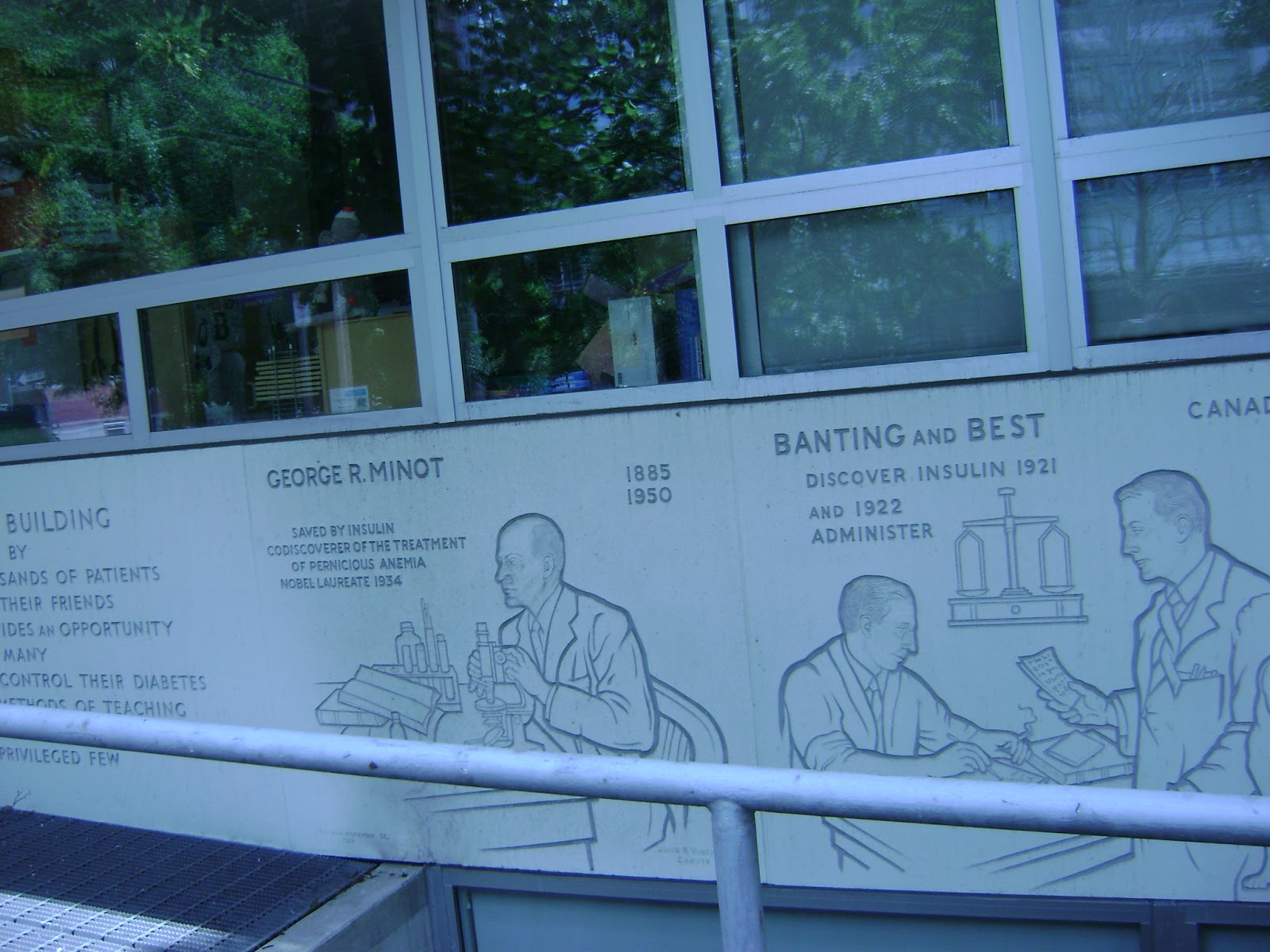
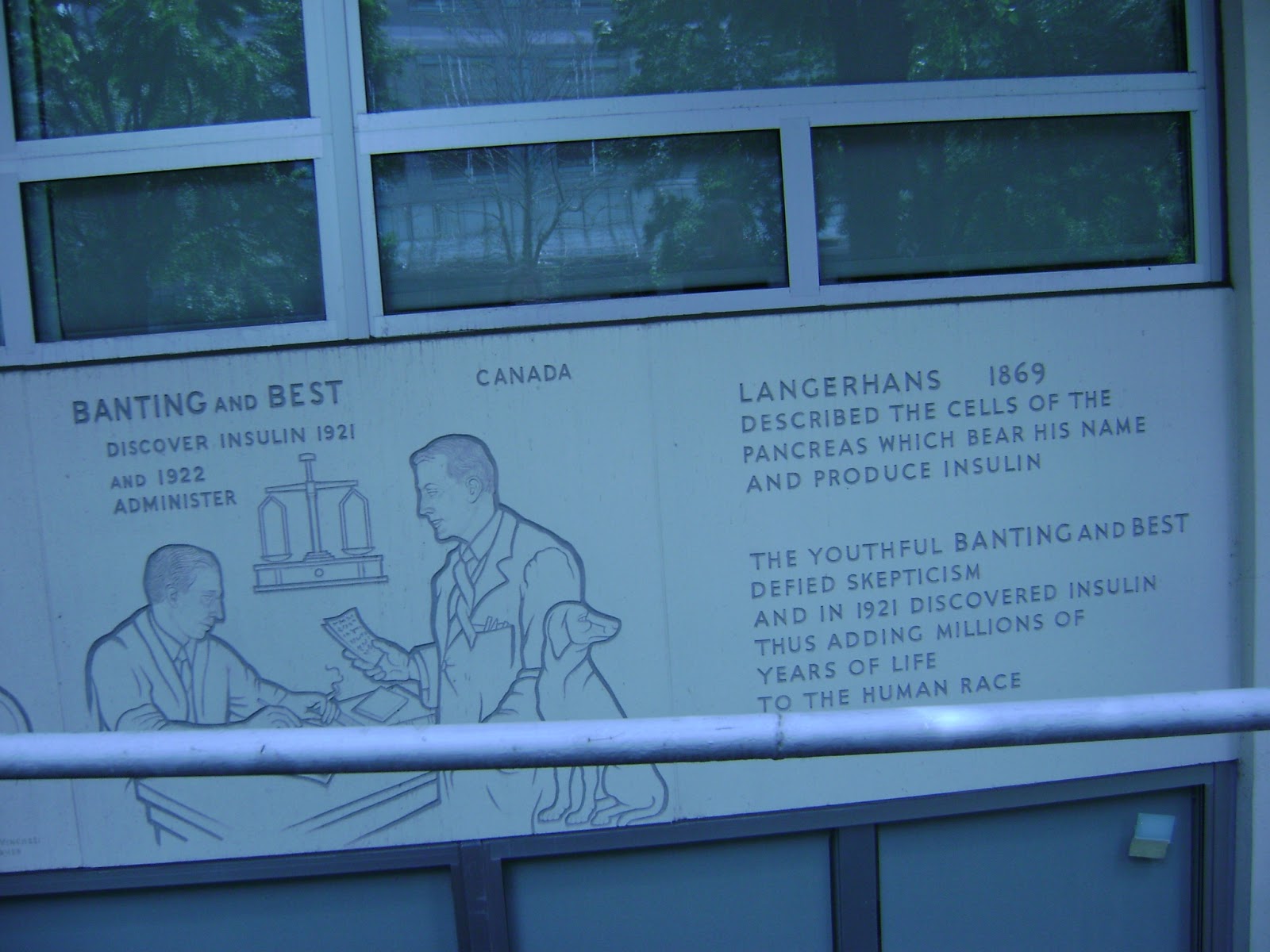
After lunch, my brother drove me to the Joslin Center.  I wandered around.  The CDE coordinator talked to me about the programs.  An entire building of people who get it.  A station to download meters and CGMs.  Upper floors of research labs (I hope Peng Yi is happy there).  The front of the building is decorated with a bas relief mural of the history of diabetic care, from ancient civilizations ending, not with Banting and Best, but with  Minot, who cured pernicious anemia, and was able to do so because he became diabetic and received insulin, leading him to realize the answer was to replace what was missing, either through diet or supplements,  We are more than placid recipients of care.  By surviving, thriving, we are able to create a better world.  Scientists like Minot, astronauts, teachers, physicians, dancers, musicians, actors....


We are a part of this world.  Not freaks.  Not gluttonous, lazy sinners to be scorned or shunned.  Not one of them, but one of us.

In Boston's South Station, I bought coffee and a croissant while waiting for my train home.  Au Bon Pain had a touch screen mounted off to the side of the register.  A plain croissant had 29 grams carbohydrate, the chocolate 57 grams.  I had the chocolate, tested, injected 6 units of insulin and delighted in the moment.

If this is how the world evolves, for all of us with diabetes, with test strips, meters and insulin, we can go anywhere and be just who we are.


Thursday, August 8, 2013

Awestruck by Science


                                                                      Peng Yi

After wandering around campus in more or less the right direction, I finally found #7 Divinity Street, Harvard Stem Cell Institute. Up 4 flights of stairs to the 3rd floor, Celia told me Peng Yi was eager to speak to me.

I had expected a handshake, a quick howdoyoudo.  Instead, we were off in search of a conference room with a white board for drawing diagrams.

Wait!  Miles of walking and all those stairs burnt up my makeshift breakfast.  I pull out my meter.  56.  I explain to Peng Yi that without glucose tablets none of his explanation will make sense to me. He patiently begins.  Green notes fill the board, which I copy onto my notebook, striving for that right balance of listening and taking notes.  How it all works.  What goes wrong.  What he saw and pieced together.

Earlier I had been frustrated by Faustman's staff overly simple reply.  Now I struggle for glimpses, glimmers of understanding.

 The body can make do with 50% of its beta cells, but when the number drops to 10%, it can't keep up.  Type 2 is a signalling problem.  Insulin resistance initially causes a proliferation of beta cells, but then the number drops to fewer and fewer of the original number.  Peng Yi induced insulin resistance.  The microarray showed that the cells were producing more of this hormone, betatrophin, that increased the beta cells.  [This last part my biochemist daughter keeps explaining to me.]

So we come to the real reason for the conference: what Peng Yi wanted me to tell the world.

This is not the dreamed-of end-of-the-bad-times moment-of-truth.  What Peng Yi discovered, what all truthful, honest and intelligent scientists discover, is how complex the endocrine system is.  He found an undiscovered piece of the puzzle and also a clue to how many missing pieces there are.  He now knows several more questions he needs to find answers to:  How does one purify this protein (echoes of Collip and Banting)?  Why do the betacells stop proliferating and die off?  Would it be disastrous for them to keep proliferating?  What other hormones/proteins are waiting to be discovered?  What's going on in the other pancreatic cells, beyond alpha and beta?

My mind is still aswirl from my meeting with Peng Yi.

The rest of the world wants to look at diabetes as if it were a preschool puzzle.  Put the square peg in the square hole and the round peg in the round.  And maybe for some, that's all they believe is necessary.  All they can handle.  At the play reading I was told not to expect the audience to understand or even be interested. "Math and science cause my eyes to glaze over."  I certainly struggled during that conference, between the detailed knowledge and recovering hypoglycemia.  Maybe my daughter can explain microarrays again.  Because the more pieces of the puzzle we can understand, the more we share which parts we've discovered, the better our chances at dealing with this thing that is becoming an increasingly bigger part of all of our lives.


Friday, August 2, 2013

Searching for Divinity

As I searched for Divinity Street, the meanderings of the paths resonated with the meanderings of my mind.  I'm an English teacher.  Analogies abound.  The paths echo my journey with diabetes.

My brother says the streets of Boston follow the meanderings of drunken cows.  Getting from the Red Station to Divinity Street, Harvard seems to have merely paved the wandering paths created by students straggling from one building to another.  Unlike the U of I's quad, whose paths form squares and triangles, Harvard's paths seem like a toddler's scribbling.  Two paths run parallel then veer off in slightly different directions. Illinois city streets and county roads are laid out on a grid.  Negotiating them is done with algebraic simplicity. To get from A to B, you go up so far and over so far. No wonder all the directions people gave me consisted of vaguely waving over that way.

When first diagnosed, I approached diabetes as a Midwesterner.  It's not a new disease.  Millenia old.  They gave me I:C ratios and correction factors and I thought I should be able to get this easily. Do this. Do that. But LADA doesn't behave linearly, logically.  My carefully constructed equations don't work out as neatly as I calculated.  I miscalculate.  Too high.  Too low.  I thought if I just studied hard enough, knew enough, I could figure out the answer.  So I read, I studied, I plowed through research papers, attended lectures and watched videos of conferences.

And then I met the staff at Faustman's lab. Nice, helpful people.  The phlebotomist was particularly skillful. But I expected a deeper understanding of diabetes. I'm used to hearing the same old, same old. The people sitting beside me on the bus and train I don't expect to get it.  But the people working in the labs, in the hospitals and clinics, with my insurance, the journalists: that's their job, what they are paid to do.  And time after time, they are the least informed, the least curious, the most mired in the past.  It's frustrating.

And I am realizing that the street I was heading for isn't Divinity either.  I turn around and look for someone new to ask.  Harvard campus is really big.

Thursday, August 1, 2013

To Diabetes Mecca and Back Again, Part 1

It's been nearly a week since my trip to Boston but it's taken this long to process.

All in all, it was a good trip.  I learned a lot, had some good experiences, met some interesting people.

A few weeks ago, Dr. Faustman's office notified  me that I could schedule an appointment to donate blood for her Phase II Clinical Trial of the TB vaccine.  When I told my brother, his wife kindly offered to set up a meeting with Peng Yi.  My husband helped me make train reservations; I got a room at the inn across the street from Faustman's lab.

When I visited my endo, she asked, "Why would you want to do such a thing?"  I explained who Dr. Faustman is and my hopes of being included in the clinical trial and maybe no longer being diabetic.  As the day approached for me to leave, I thought about her question.  After some bad experiences with incompetent phlebotomists six years ago, blood draws make me anxious.  Some days, I avoid leaving the house.  Worrying whether I have everything I need (glucometer, insulin, test strips, glucose tablets, juice box, raisins), worrying about bottoming out just as I walk out the door, or halfway through my errands.  But if that Spanish astronaut can go to the space station, I told myself I could make it to Boston. I kept telling myself it would be worth the anxiety.

Sometimes when things don't meet our expectations, it's because they are both better and worse than we imagined.  This trip was a mixture of both.

2pm Monday, I left the house, walked most of the way to the bus stop, only to see the FedEx truck with my CGM sensors aboard head for my house.  Not wanting them to sit out in the heat, I walked back home, took them inside, and headed back to the bus stop.  The bus let me off outside the art museum.  I walked several blocks to the Union, only to be told that the bus would pick me up somewhere outside the art museum.

By the time I was finally aboard the train, I was missing my husband.  No one else would get the Chekovian Seagull humor of the Slovakian teenager, dressed in black, reading 11,0002 Ways to Be Miserable and wonder if her name is Masha, or hear W C Fields saying "Philadelphia will do" as my Parisienne seatmate studiously underlines the sites of Philadelphia in her guidebook.  It's going to be a long time until Friday.

Twenty-six hours later, around midnight, I arrive at the inn.  One working toilet, one working sink (not in the same bathroom) for two cars of people and one of them catches fire, causing further delay.  More shocking than the electrical fire was the apathy of passengers and crew.  I went to the sleepers, figuring the crewman would come to kick me out and I could tell him our car was filling with smoke.  "It happens."

Faustman's lab is in a glass and steel building with a waterfall below a glass ceiling.  Dr. Faustman was not in that day.  I asked the person taking down my information and the one drawing my blood what they wanted people to know about diabetes.  "There are two kinds."  My heart sank.  I came all this way for that?  That's like hearing the newest model car will have 4 wheels.

People were very helpful on my trip over to Harvard.  The phlebotomist wrote out which shuttle and subway train to take; the girls on the shuttle pointed me toward the Red Line Station.  So far so good.  Day two and I'm not lost yet.

Spoke too soon.  The people at Harvard may be brilliant but their directions to Divinity consist of waving over this way.  I suppose that's to distinguish between back that way.

Tune in tomorrow for the continuing story.


Monday, July 22, 2013

How Dare the IDF!

The IDF just released its new video.  Very anime.  And a noticeable break with the past.  All the people are thin.  Oddly enough, that's what most of those commenting object to the most.  "Why aren't they identified as Type 2?  Why aren't they fat people gulping soda and stuffing their faces with fast food?"

I commend the IDF for being brave enough to dispel this stereotype.  To go with what science has been saying rather than what people want to believe.

But why do these people fight so hard for those lies?  They are the first ones to scream about how they and their children are not to blame for their diabetes.  How they are not fat (although many T1s are equally round). How sugar is not the cause and yes, they can eat that cookie.  They are the ones that want the world to know that this is not a disease that can be prevented or controlled easily with diet and exercise, at least not for them.

The IDF gave them what they wanted and they hate the IDF for giving it to them.

Even the ADA will  go only so far as to say that obesity is linked to diabetes.  Linked.  Not a demonstrated cause as in this always causes that to happen.  Most people who are overweight maintain normal blood sugars.  Many diabetics are thin.  And I doubt if those screaming the loudest about the Diabesity Epidemic have ever read the research reports.  Have they noticed the cherry-picking?  Have they looked at the numbers?  I have.  It's amazing how many research dollars go toward perpetuating this fiction, but no one ever complains.

Recently, researchers all over the world have started looking at other causes.  DNA strands.  A people's history.  More and more of them are concluding that it is not the opening of the McDonald's or the availability of a cold Coke, but the centuries of starvation.  Of course, governments would rather blame evil American corporate greed than their own political/economic policies that decimated their own population.

It is a greater evil to say to a people who no longer watch their children die of starvation that they deserve to die of diabetes if they now have enough to eat.